Launched at the end of 2025, the national communication campaign was developed by Nossa and Nova Expressão, the two agencies that won the tender with a €4.3 million proposal.
The Portuguese Environment Agency’s (APA) “Vamos Lixar o Lixo” campaign achieved 510 million contacts on television and 412.9 million through outdoor advertising. A study conducted by the Institute of Marketing Research (IMR) also indicates that one in three citizens (33%) say they have recently changed their behaviour as a result of awareness campaigns.
Launched at the end of 2025, the national communication, awareness and information campaign dedicated to waste, developed by agency Nossa with media planning by Nova Expressão, was present on television, radio, outdoor advertising and digital media, as well as through community outreach initiatives. The two agencies won the tender with a €4.3 million proposal.
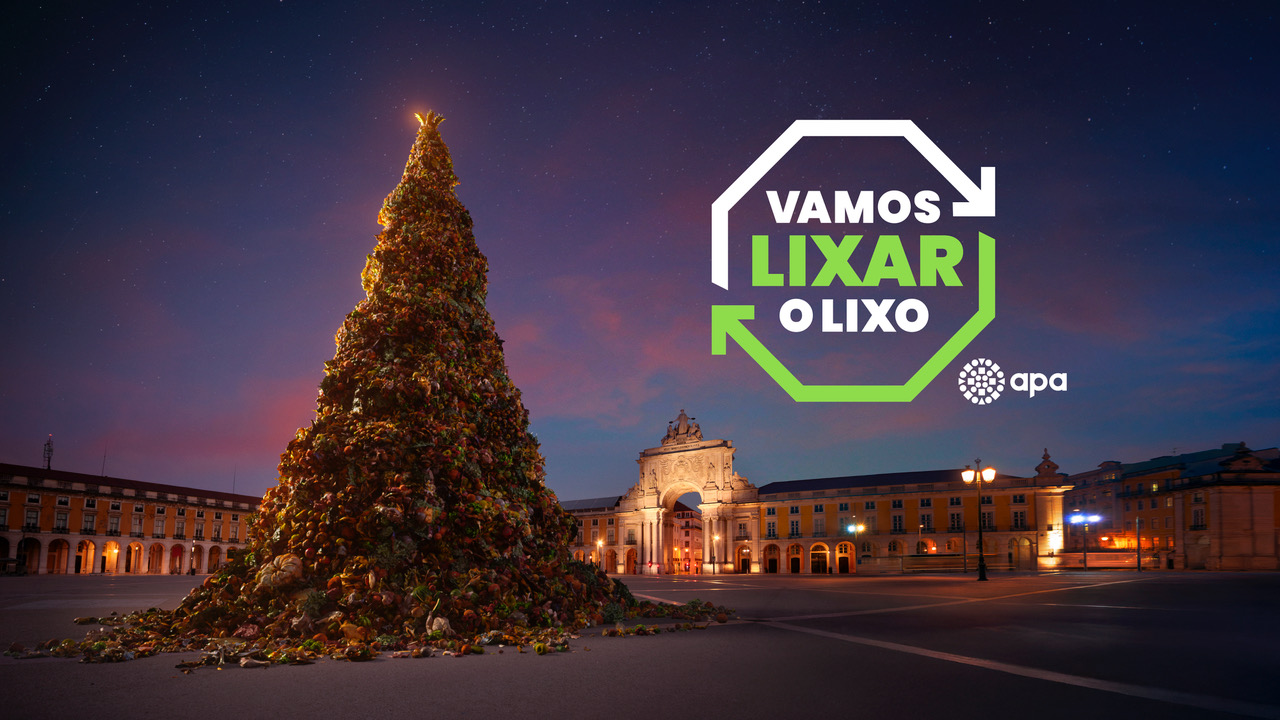
Under the motto “Let’s separate waste before the future goes to waste”, the initiative sought to raise awareness of the amount of waste produced in Portugal, highlight the importance of proper waste separation, particularly biowaste, and demonstrate the impact that small actions can have on reducing landfill disposal and recovering materials.
The quantitative study conducted by IMR, based on 800 surveys — 400 before the campaign and 400 after the campaign — also reveals that 10% of respondents say they increased their engagement with recycling.
The campaign achieved total recall of 68.5%, with 19.3% of respondents recalling it spontaneously. The overall assessment was also “very positive”, with 82.8% of respondents expressing general approval, 79.3% considering the campaign attention-grabbing and 74.8% describing it as memorable.
The study also identified five behavioural profiles regarding recycling: convinced loyalists (34.7%), moderate adopters (12.9%), selective supporters (21.4%), occasional sceptics (9.8%) and non-adopters (21.2%). Following the campaign, the proportion of non-adopters decreased, APA states, without providing figures.
Selective collection of biowaste increased by 6%
During the campaign period, between the end of 2025 and September 2026, selective collection of food biowaste increased by 6%, according to provisional data, with a particularly strong impact in August. APA also reports a similar trend in the selective collection of other materials deposited in green, blue and yellow recycling bins.
“Although we still have a long way to go in improving selective collection figures, with a direct impact on the recycling rate Portugal has been achieving, and although the figures relating to 2026 performance will only be confirmed after the end of the year, the results achieved appear to indicate that communication campaigns have an impact on the behaviour of the population,” says José Pimenta Machado, president of APA, quoted in a statement.
He argues that the waste sector should support APA in this mission, namely by strengthening collection resources and creating incentives for waste separation, ensuring continuity of the message.
Over the course of almost a year, the campaign also included several public awareness initiatives. During the summer, a travelling roadshow visited Coimbra, Aveiro, Braga, Castelo Branco, Évora and Portimão over 18 days.
During the Christmas period, APA installed a six-metre Christmas tree made from waste at Cascais Xmas Village, in Parque Marechal Carmona, accompanied by a “Loja de Lixo”, where visitors could exchange waste for gifts. During the sales period, the campaign also organised activations at Centro Comercial Colombo and NorteShopping.
The creative concept was developed by Nossa, while Nova Expressão was responsible for the media strategy and dissemination across the different channels. Corpcom was the agency responsible for the campaign’s press relations.
“A year ago, we launched the ‘Vamos Lixar o Lixo’ challenge with the aim of mobilising the Portuguese around an issue that concerns us all. We managed to reach millions of Portuguese people across different channels and through the various community awareness initiatives, which we hope represents some degree of behavioural change,” says Nuno Presa Cardoso, partner and chief creative officer at Nossa, stressing that changing behaviour requires long-term work that does not end when the campaign finishes.
The campaign was supported by the Environmental Fund and co-financed by Sustainable 2030, Portugal 2030 and the European Union.
Study methodology
The IMR study covered citizens residing in Portugal aged over 18 and was conducted through an online survey. The sample consisted of 400 pre-campaign surveys and 400 post-campaign surveys, using a random sampling methodology stratified by gender, age, region and household composition.
Data collection took place in two phases. The pre-campaign study was conducted between 10 and 20 December 2025, while the post-campaign study took place between 20 August and 5 September 2026. In terms of statistical validation, the study has a 95% confidence interval and a sampling error of ±4.90%.