The Portuguese Environment Agency (APA) campaign, developed by Nossa and Nova Expressão, achieved 68.5% recall and 510 million contacts on television. Looking back on more than a year of work, the agencies highlight the ability of provocative language to capture attention, the response from younger generations and the importance of combining traditional and digital media with proximity initiatives.
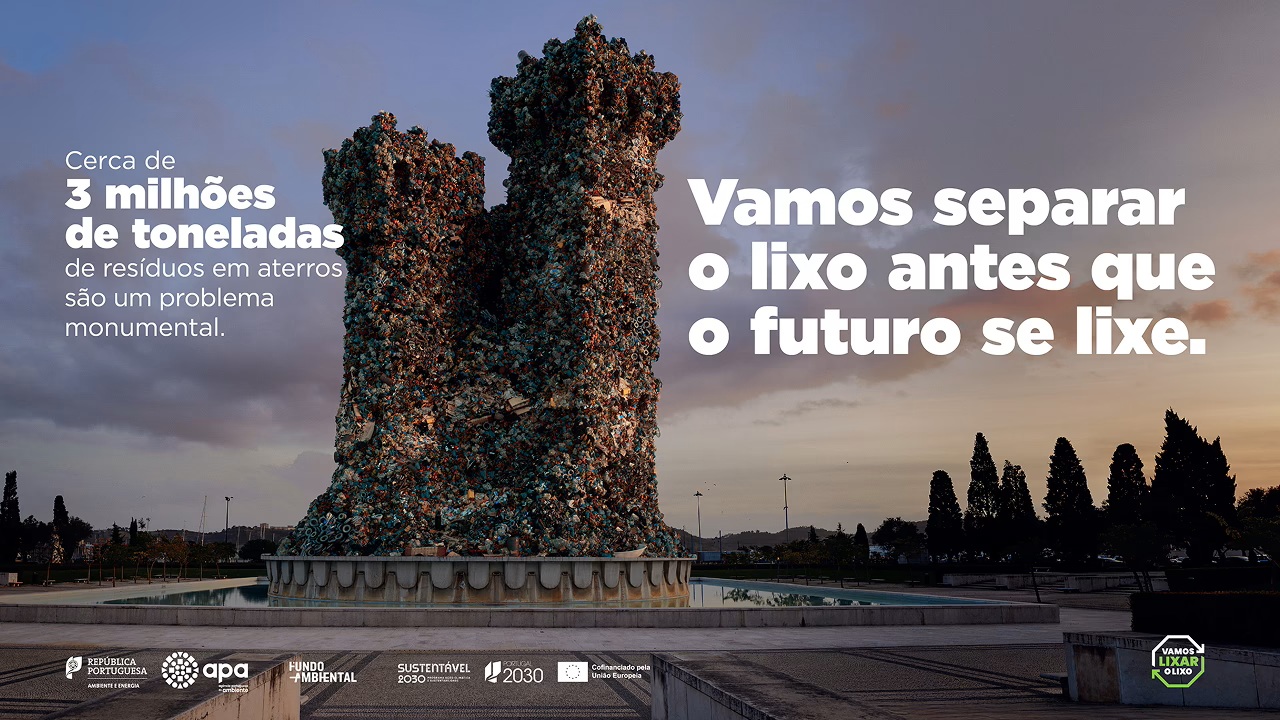
Launched in October 2025, the ‘Vamos Lixar o Lixo’ campaign began with a diagnosis: although waste separation is recognised as an important practice, there was still some lack of awareness about the scale of the problem in Portugal and a need to change behaviours.
Nossa’s creative response involved moving away from the institutional language traditionally used in environmental communication and adopting a more direct, provocative and relaxed approach. According to Duarte Durão, co-founder and managing partner of the agency, this choice required some courage, particularly given that the proposal was submitted as part of a public tender.
“We knew that if we went with a politically correct approach, we would end up among many others that would probably use the same kind of message,” he explains to M&P during the presentation of the campaign results, held today, 24 November, at the Vila Galé hotel in the municipality of Oeiras. The challenge, he stresses, was to find a balance between a “strategy supported by studies and insights” and an approach disruptive enough to stand out.
“There is no point in us, as a system, continuing to insist that people put waste in the appropriate place. There was this desire to explain to the Portuguese Environment Agency (APA) that we had to call things what they are and that we had to create this ‘Vamos Lixar o Lixo’ platform,” he adds.
For Duarte Durão, the organisation’s openness was decisive in the development of the work. “One thing is to win a tender and then be confronted with people and teams asking us to make certain changes or adjustments. That was not the case here.”
He highlights the trust placed in both Nossa and media agency Nova Expressão, as well as APA’s openness to the recommendations presented. “They listened, accepted the suggestions, and that is how we built a creatively relevant and impactful campaign that also aims to provoke.”
During the presentation, Duarte Durão also explained that the intention was not only to raise awareness of the amount of waste produced, but also to involve citizens in solving the problem. “There was some lack of awareness of the true scale of the problem. People who live far from landfills do not know that it is, in fact, unsustainable.”
The campaign therefore sought to provoke a reaction and turn the message into an invitation to participate. “We wanted to shock, to create a genuine sense of warning, saying ‘não podemos continuar assim, é preciso fazer alguma coisa’. But we also wanted to involve people, make them feel responsible and make them feel that they have to be part of it.”
The decision to use the word “waste” rather than consistently relying on more institutional terminology was also part of this attempt to bring the message closer to everyday life. “In everyday life, we need to speak like people dealing with their waste and where they put it. We felt this simplification was also important and so, it really is waste,” he explained.
The choice of the influencers who became the main faces of the campaign, Joana Marques and João Manzarra, was made jointly by Nossa and Nova Expressão in order to add different dimensions to the communication.
“Joana Marques has an ability to use humour and play with topics that we felt was important. We did not want this to have an overly aggressive tone. We wanted a campaign that would reach people, challenge them and concern them, but with a little sense of humour,” explains Duarte Durão.
In Manzarra’s case, the agency primarily sought a connection with environmental issues. The influencer visited a landfill to understand the reality of waste disposal and produce content based on that experience. “Affinity is essential for the content to come across as authentic and credible,” he stresses.
The media strategy, developed by Nova Expressão, sought to ensure a cross-channel presence, combining television, radio, outdoor advertising, press, digital and direct contact initiatives with local communities.
Nuno Machado, international account director at Nova Expressão, highlighted the need to use different tools to reach different audiences.
“This project grew from a clear ambition, which was to bring the issue of waste into the public sphere, and for that we developed an integrated communication strategy involving radio, digital, traditional media, less traditional media and direct contact with communities,” he explained.
The plan was organised around two periods considered particularly sensitive: Christmas, when waste production increases, and summer, when usual waste separation habits may be disrupted by holidays. Television and outdoor advertising played a central role in both waves of communication, while digital ensured continuity of the message between these periods.
“It was digital that ensured the campaign was not forgotten between these two very strong waves,” said Nuno Machado, who also highlighted the production of specific content for different platforms and audiences.
The strategy included a presence on Instagram, Facebook, TikTok and X, as well as on different websites and digital platforms. Content was adapted to each channel and its respective audiences, seeking to address the fragmentation of media consumption habits.
On television, the campaign achieved 510 million contacts, while outdoor advertising recorded 412.9 million. The strategy also included national and regional radio stations, seeking to ensure coverage across the entire country. In digital, the approach combined advertising formats, owned content and amplification through influencers.
The campaign also moved beyond media channels to reach people directly. The roadshow travelled through six cities — Coimbra, Aveiro, Braga, Castelo Branco, Évora and Portimão — over 18 days. At Christmas, a six-metre tree built from waste was installed at Cascais Xmas Village, accompanied by an initiative in which waste could be exchanged for gifts, allowing around 200 kilograms of materials to be collected.
For Nuno Machado, the combination of media presence and direct contact was essential. “It was about being on the ground while, at the same time, announcing that we were there. People value that.”
Press relations, handled by Corpcom throughout the project, were another component of the communication strategy, helping to keep the issue on the media agenda and amplify the various initiatives developed.
The assessment also includes the results of a study by the Institute of Marketing Research (IMR), which indicates total recall of 68.5%, with spontaneous recall of 19.3%. Overall approval reached 82.8%, while 79.3% of respondents considered that the campaign successfully captured attention and 74.8% described it as memorable.
One of the results that most surprised Nossa was precisely the response from younger audiences. Despite the weight of television in the media plan, Generation Z stood out in campaign recall, both spontaneous and prompted.
“We were more sceptical because it was a media plan with a strong television component,” acknowledges Duarte Durão. “For this to be one of the groups that remembers the campaign best was a great surprise for us.”
He also highlights the positive evaluation of the campaign, particularly given the tone chosen. “Campaigns like this, which also aim to provoke, sometimes do not generate much approval. Here, because it is a cause that we all know needs to be addressed, I think that also excuses the ‘aggressiveness’ of the communication.”
Despite the positive indicators, Nossa’s representative made it clear that change cannot be achieved through a project lasting just over a year. “This is not work that can be done in one year. We have been communicating with people for many years. We have to keep working on this continuously.”
APA also considers that there is still a long way to go, advocating for the continuation of campaigns and stronger proximity to local communities, accompanied by better collection conditions and incentives for waste separation.